Translate

Wednesday, November 9, 2016

CANNIBAL FEROX (1981)

CANNIBAL FEROX (1981) (UR)
aka MAKE THEM DIE SLOWLY
Director: Umberto Lenzi
93 minutes
Italy
 
I rented this movie back in 1994 on VHS, but had to return it before I had the chance to watch it. Then I moved and couldn't find a copy in my local stores. Now, in 2016 I have a uncensored DVD via Grindhouse Releasing and I have to say, this movie lives up to its infamous reputation.
 
Our three main characters, Gloria, Pat, and Rudy, travel to the Amazon to find evidence that corroborates Gloria's P.H.D. thesis: that cannibalism is a myth concocted by white European imperialists to justify their annexations of foreign countries. She intends to prove this by seeking out a tribe known for their alleged practices and proving that said cannibalism is poppycock.
 
Whilst traveling deeper into the jungle, our "heroes" are made to abandon their vehicle after it becomes stuck in a deep puddle of mud. They continue on foot and come across two other Americans whom claim to have been attacked (and one wounded) by the cannibals. They join forces and come across the tribe's village.
 
Without spoiling the rest of the movie, I'll just say that things (and people) are not what they appear. What happens next is gory, and disturbing, to say the least. The film hosts a bevvy of genital mutilation, attempted rape, misogyny and animal mutilation. It rivals the mighty Cannibal Holocaust in these respects. Similarly to Cannibal Holocaust there are intercut scenes of a police investigation taking place in the United States, juxtaposing with and giving some respite to the jungle horror.
 
The cinematography is great, as is the soundtrack. The acting is on par with Italian films of that era, wherein you can ascertain the emotion, but the dubbed dialogue and script, translated from the Italian, are clunky at best. This is clearly evident in the film's somewhat confusing conclusion.
 
Overall, this film is not for the faint of heart and the grim nature will disturb many viewers, especially considering the aforementioned mutilation and animal deaths. Yet, for those who can stomach this type of material, the film is a rewarding exercise in utter depravity. I recommend it to those who regularly seek out such exercises.
 
8/10

Thursday, October 13, 2016

PHANTASM: RAVAGER (2016)

PHANTASM: RAVAGER (2016) (R)
Director: David Hartman
85 minutes
United States


After 18 long years, the world finally has its next and final Phantasm film. Filming began in 2008, envisioned as a webseries tentatively titled "Reggie's Tales". Filming wrapped in 2014, and the installment was announced publicly, but due to post-production problems and distribution negotiations, it would not be released until 2 years later in October of 2016. In the interim, fans were clamoring for information, the hype became fever-pitched, and aggravations grew.

 
The Phantasm franchise has always had a special place in my heart. Though it is utterly perplexing at times, I've found it to be one of the most consistent horror franchises, due to its reoccurring cast and the solid direction of Don Coscarelli in parts 1 through 4. Part 5, however, is directed by David Hartman, a protégé of Coscarelli's, and announcement of this switch-up in 2014 had caused concern amongst the hardcore fans of the series.


This long awaited installment is likely to be highly divisive. Viewers are either going to love it or hate it, with very little middle ground. That was to be expected, given the same fan response to part 4. Reggie is the focus here, rather than Mike, and he is dimension-hopping through three different timelines. One follows the conclusion of part 4, one is in a post-apocalyptic future wherein the Tall Man has eradicated the Earth, and one in which Reggie is a resident of an old folk's home, dying of dementia. All three of these timelines begin to coalesce and poor Reggie, as well as the viewer, can't figure out which reality is real.


Having been filmed with almost no budget, the special effects take a big dip from previous installments. It is also abundantly apparent that the film was a patchwork of old footage, webisode footage and new material meant to pad the runtime. It is disjointed and schlocky and comes across like a Troma film without the humor. Despite these flaws the film, at least for me, it still works.
 
As for closure to the franchise, there is a lot of room for interpretation. The film requires the active participation of the viewer, as you have three endings to choose from. Yet it remains true to the spirit of the original and its themes of loss and mortality. It even makes sense of the rather nonsensical beginning of part 2. Overall, if you are a fan of the series, this film is like a bleak and somber love letter. If you haven't seen the first 4, watch them before you dig into Ravager or you will be utterly lost.

"Ice cream man. It's all in his head." - Phantasm 4

7/10

Wednesday, September 7, 2016

ORCA THE KILLER WHALE (1977)

ORCA THE KILLER WHALE (1977) (PG)
Dir. Michael Anderson
United States
 
 
When an ambitious fisherman, Captain Nolan (Richard Harris), has an encounter with an orca at sea, he becomes convinced he and his crew can capture one to sell. Against the protests of whale expert Rachel Bedford (Charlotte Rampling), Captain Nolan and his shipmates depart in search of their latest cash cow. Having tracked a pod of orcas, Nolan attempts his capture, but only succeeds in clipping the dorsal fin of a male orca, and fatally wounding its pregnant mate.
 
 
Dejected and horrified by his own behavior, Nolan and company return to port whilst defending against the male orca's grief-ridden attacks on his ship and crew. Meanwhile, the orca has followed their trek back to their small town, and begins to wreak havoc on the town's fishing economy, as not only does the orca drive away the fish, but begins destroying their infrastructure as well.
 
 
The townspeople are notably angry with Captain Nolan for the orca's attacks, and the Captain is struggling with his own depression and tragic past. With public pressure surmounting and with a bit of coaxing from the poorly-dubbed Umilak (Will Sampson), Nolan sets sail to finally confront the murderous whale.
 
 
Orca the Killer Whale has oft not been lumped in with the other Jaws knockoffs that began to appear in the latter half of the seventies. Unlike movies like Grizzly, however, Orca really isn't a Jaws retread, rather it is more of a modern retelling of Moby Dick. Nolan is very much an Ahab-type whose slow decline into madness is equaled only by the grieving whale he's hunting. Although much of the pseudoscience of the movie begs for nitpicking (orcas are not monogamous animals, for one), these minor flaws are outshined by the lush cinematography, the psychological narrative and an excellent performance by Richard Harris. It is by no means a perfect movie, and cannot compare with the almighty aquatic horror of Jaws, but it is an entertaining, and at times, a surprisingly grim watch. Oh, and Bo Derek is in this film for about five minutes.
 
6/10
 
I'd like to thank Wildman Willis for sending me this movie on DVD. Every 25th subscriber he gets to his Youtube channel wins a package full of DVDs and comic books and I won the first. You can be next! Check his Youtube channel out here:  https://www.youtube.com/channel/UCfIYemkbBUJJA1mk9OKsoiQ

Thursday, September 1, 2016

O ESTRANHO MUNDO DE ZÉ DO CAIXÃO (1968)

O ESTRANHO MUNDO DE ZÉ DO CAIXÃO (1968) (NR)
aka THE STRANGE WORLD OF COFFIN JOE
Dir. José Mojica Marins
80 mins.
Brazil


This was my first introduction to the universe of Zé do Caixão, known to the English world as Coffin Joe, and it was a glorious introduction indeed. Gory, depraved, arty and exploitative, director and star José Mojica Marins not only pioneered Brazilian horror with his Coffin Joe series, but carried with it a post-modern philosophy and critique of society's morality and class.

This particular entry is an anthology of three tales demonstrating the triumph of instinct over reason, a thesis that Joe himself asserts in a narration over the opening credits. The first story is called O Fabricante de Bonecas, or The Dollmaker. The titular artisan works at home with his five daughters, all of whom look like they're in their thirties, wear vestial white gowns, each having their own creepy, oversized and eyeless doll.


A group of men conspire to rob the dollmaker in his home, believing him to be the owner of a substantial treasure. After beating him and brandishing a knife, the old man blacks out after suffering what appears to be a heart attack. One of the men discovers the dollmaker's daughters and the group turn their attention away from treasure and towards rape. The women have their own deadly secret, although, to which the men soon discover.

In "Kara" ("Obsession"), the second vignette, we are introduced to a homeless addict who holds balloons in the street and spies on a specific woman through her window, as she disrobes and bathes in her apartment. The creepy hobo becomes fixated on the woman and follows her around town as she obliviously lives her life, shopping, dating and even eventually becoming married. You might think you know where this story is going, but you don't. The twist midway is truly unexpected and allows for the real horror of the piece to unfold in its climax.  


The third entry, "Ideologie", constitutes the real meat of this film. Professor Oaxiac Odez (Zé do Caixão reversed, and a probable alter-ego of the character) is being interviewed on a TV show about his theory that love does not actually exist, and that instead we are creatures of instinct and convenience. One of the journalists strongly disagrees with the professor, and after the interview concludes,  Odez invites the the dissenting journalist and his wife to his home for a demonstration of his philosophy. When they arrive, Odez (in scenes foreshadowing Blood Sucking Freaks) conducts a prurient show of sadism, cannibalism, and debauchery to prove to the couple that survival trumps any and all notions of human love.

 
The anthology is well written, directed and acted. The jerky editing adds to the thick atmosphere of the film, and is reminiscent of early surrealist editing, like that found in Cocteau's The Blood of a Poet, or Bunuel's Un Chien Andalou. José Mojica Marins is a ferociously original filmmaker, and is criminally obscure. His name should be spoken in the same sentences that invoke Jodorowsky, Lynch, and Russell. Having now seen many more films in his oeuvre, I can attest Marins has perfectly grafted horror, arthouse and exploitation into a potent concoction and in doing so, created an aggressively unique body of work that challenges the viewer, deconstructs social mores and entertains like no other. Highly recommended!

8/10

FULL MOVIE:
 

Thursday, August 7, 2014

BY SWORD, BY AX, AND WITH PITH: AN INTERVIEW WITH ANGELA VOORHEES OF AMERICAN HORRORS

BY SWORD, BY AX, AND WITH PITH: AN INTERVIEW WITH ANGELA VOORHEES OF AMERICAN HORRORS
 
 
Angela, host of Angela's Trailer Park, is one of the most eccentric horror reviewers out on web, because rather than just knit picking fake efx  shots or slamming shoddy writing, he rather praises his subjects for their entertainingly campy and bloody forays into the genre. With an equally eccentric image and DGAF attitude to boot, he provides an alternative to the oft oversaturated web geekery.
 
Thee Satanophile: If you could remake any horror series, which would be and how would you improve it?
 
Angela Voorhees: The ones I would want to remake or do my own thing left, I’m not good enough to do so. Haha.
 
Thee Satanophile: Maniac (1980) vs. Maniac (2012)
 
Angela Voorhees: William Lustig’s Maniac. The remake was unwatchable for the sole reason of [the] POV 98% of the flick.
 
Thee Satanophile: Favorite non-horror film?

Angela Voorhees: Mallrats, Pink Flamingoes, Grease (CD in car at all times), Party Monsters, and Rock n Roll High School.
 
Thee Satanophile: First and last movie to scare then shit out of you?
 
Angela Voorhees: Texas Chainsaw Massacre (1974). 5 year old me was pissing himself. The Conjuring from last night.
 
 
Thee Satanophile: If you were the scriptwriter for Ghostbusters 3, what should I expect?
 
Angela Voorhees: I’d pass because I’m not the biggest Ghostbusters guy. It’s not a bad movie, just
never had the love for it like most do.
 
Thee Satanophile: Who are your favorite reviewers in the Reviewsphere?

Angela Voorhees: The Cinema Snob and [anything] 12:01 Beyond related.
 
Thee Satanophile: Death match! Maniac Cop vs. Terminator.
 
Angela Voorhees: Psycho Cop!
 
Thee Satanophile: Death match! Laurie Strode vs. Jamie Strode.
 
Angela Voorhees: Tom Akins.
 
Thee Satanophile: How true to your life is the character of Angela Voorhees?
 
Angela Voorhees: A louder one I guess.
 
Thee Satanophile: Favorite bands? The Germs are a given.
 
Angela Voorhees: Marilyn Manson, GWAR, GG Allin, The Misfits, Danzig, Skid Row, and anything with Keith Morris.
 
Thee Satanophile: Your family was all about horror, as you were growing up, which I feel (maybe I'm wrong) is exceptional for many of us. Tell me about that upbringing.
 
Angela Voorhees: My Disney films were Godzilla flicks. In Kindergarden I was sent to the principal office for my Friday the 13th lunchbox. It was very much a open househould and my mom is the reason I'm doing this today.
 
Angela's Trailer Park appears on American Horrors on Mondays

Thursday, July 17, 2014

INTERVIEW WITH LESLIE RICE OF TERROR OBSCURA

INTERVIEW WITH LESLIE RICE OF TERROR OBSCURA
 
 
Leslie Rice, aka the Fear Fan, is the writer/director and star of the web series Terror Obscura, a review show that tackles the horror genre. Mr. Rice takes a more analytical approach than most reviewers, and he opts to review entire franchises, giving each installment in a series its own episode. Also, he offers shorter, truncated reviews on a show called Fright Bites, to appease fans in between episodes of Terror Obscura. The following is an interview I conducted with Mr. Rice, wherein we discuss the philosophy of horror, what's up next for both shows, and which horror icon would survive in a fight to the death. 
 
Thee Satanophile: What do you think makes horror unique? What separates it from genres that include similar themes of murder or crime (i.e. drama, sci-fi)?
 
Leslie Rice: Well, that's a very interesting question, and I think it can best be answered by defining the term 'Horror'. If you were to go through each of the other genres and evaluate them, you would eventually be able to boil them down to a single term or phrase that describes what feelings or thoughts they were meant to inspire. For example, you might get something along the lines of 'speculation' when you talk about Sci-fi, or 'excitement' when discussing Fantasy. When discussing Horror though, the primary goal is to inspire 'Fear'. Think about it - you can have any of those other genres, but whenever that element of Fear creeps in, they become a hyphenate. "Sci-fi horror." "Horror Comedy."
 
Thee Satanophile: Would you say, then, that other genres, like comedy for example, essentially contain elements of horror? Furthermore, if we can equate horror with conflict, then horror is the jumpoff for narrative storytelling in all genres. Hell, when Mr. Hooper died on Sesame Street, was that not a form of horror narrative?
 
Leslie Rice: Ha ha! While I admit that's an interesting idea, I think that saying all genres contain elements of horror is like saying that you and I contain elements of an elephant seal - we're made of the same stuff, but what really matters is how it's put together. All narrative storytelling requires conflict, but what makes horror... well... 'Horror'... is the consistency of that conflict - man vs. fear. When you look at every single horror movie, what you'll find lying under the surface is a particular fear, or combination thereof. What if my kid turns out to be a terrible person (The Good Son, The Bad Seed, Children of the Damned)? What if everyone really IS out to get me (Invasion of the Body Snatchers, The Faculty, Invaders from Mars)? What if the Boogeyman actually IS real (Nightmare on Elm Street, etc.)? While everything contains the POTENTIAL for horror, it's only when they begin to focus on one of those questions that you get a true horror story. Like you said though, most things do contain some trace elements of fear, and I think that's why so many other genres mesh so well with horror- because it's already got the seeds there. It's not really TOO surprising given that fear is one of the oldest human emotions.
 
Thee Satanophile: What was the first horror film you watched as a kid? Also, what's the last movie you saw that authentically scared you?
 
Leslie Rice: Looking back, it's difficult for me to say what the FIRST was, but I DO recall the ones that first managed to scare the crap out of me. While I always liked the classic Universal Monster movies as a kid, the first thing I remember actually scaring me is the Disney version of Sleepy Hollow. There was just something about that insane cackle and how damn RELENTLESS he was. No matter what poor Ichabod Crane did to get away, that sword was always just a few seconds away from taking a little too much off the top. If I had to give you a runner up, it was Forbidden Planet, although that's not technically a horror movie. There was something about the Id Monster that messed with me.There, it wasn't just the fact that it was invisible, or that it was invincible, it was that godawful ROARING sound it made. Awesome stuff. As for things that've scared me recently, I've got to admit that it's been slim pickings as far as stuff that's actually FRIGHTENED me to the point where I was legitimately scared. There have been plenty of films that startled me or made me a little uneasy, but I'd say the best bang for my buck in the last few years were the Insidious movies. THOSE are films that know how to use atmosphere, creative setups, and yes, the occasional jump scare to great effect. There have also been some pretty good smaller, independent films, but since I generally watch those on the small screen, I'm afraid their impact is lessened considerably...
 
 
Thee Satanophile: Let's play death match! Round one is The Tall Man vs. Pinhead.
 
Leslie Rice: That's an interesting one... Since Pinhead is primarily concerned with the souls and flesh of the living while the other is a collector of the bodies of the dead, it's kind of hard to think of a reason they would come into conflict, but if they did, I guess we'd have to look at what they have to work with.
 
All right - let's start with the Tall Man! He's an extra dimensional being who can be killed, but no matter how gruesome the death, he can simply send another one of his multiversal doubles through to take his place, provided there's a gate nearby. Then there's his arsenal- A finite number of 'turned' replicants and human collaborators as well as a theoretically unlimited supply of dwarf minions and HK spheres as well as the occasional master sphere. On top of that, there's his own prodigious size, strength and transformative abilities to consider.
 
Then, there's the cenobites! Acolytes of a dark god, shapers of flesh and bringers of both pleasure and pain. Capable of appearing at any point after being summoned and arguably invulnerable to anything other than losing the favor of Leviathan or having the Lament Configuration's alignment altered. They bring with the blades, stabbing weapons, and the hooks that their leader can summon from the shadows.
 
So, who would win? Well, the Tall Man has the advantage of numbers and not having a soul, as well as some experience with interdimensional travel. The Cenobites on the other hand... Well, I tend to disregard pretty much anything from the second movie on, so really the only way I can see them coming out on top is by recruiting and converting enough new cenobites to send them out and close all the gates at once. So yeah, I'm giving this one to good ol' Angus Scrimm, the Tall Man.
 
Thee Satanophile: Round two! Peter (Dawn of the Dead 1978) vs. Daryl Dixon.
 
Leslie Rice: Sweet picks! As for Peter vs. Daryl... Peter. Because Ken Foree, motherfuckers.
 
Thee Satanophile: Can't argue with that. Round three! Count Jackula vs the Horror Guru.
 
Leslie Rice: Shit... Another tough one, lol! Well, if they both do one another in, there'd have to be SOMEONE to step in and fill the gap... (Conspicuously adjusts collar with a wink.)
 
Thee Satanophile: Who are your favorite producers in the "reviewsphere"?
 
Leslie Rice: Well, I refuse to play favorites with my friends on the Booth, and I can honestly say that I love all their work equally. Of the larger, better known critics, I'd probably say my top 3 are Doug, Phelan, and Brad. I'm always looking at others who are just starting out, or who have managed to carve out their own fanbases, and I'm always amazed by the amount of effort and love people put out for their work.
 
Thee Satanophile: In your Friday the 13th Part 3 review, you tackle the Jason-as-a-rapist controversy, but I noticed you didn't mention Tracie Savage's character Debbie's alleged pregnancy.
 
Leslie Rice: Yeah... Video was already 35 min... Didn't want to push it too far and besides, I didn't have much to say on it since it didn't affect things too much.
 
Thee Satanophile: I had always taken that character's comments about being pregnant as sarcasm; her and her boyfriend were constantly ribbing each other. If her character was intended to be pregnant, though, I think that would make her death more savage.
 
Leslie Rice: Yeah, she says it a couple of times, but he doesn't ever ACT like she's pregnant, so who knows?
 
Thee Satanophile: If I'm not mistaken, A Nightmare on Elm Street is your favorite franchise, am I right?
 
Leslie Rice: Hmn... Let's just say favorite 'straight' horror franchise.
 
Thee Satanophile: OK... which do you prefer... Freddy as a child molester/killer, or Freddy as just a killer?
 
Leslie Rice: Well, while it was never explicitly stated in the original series, it WAS heavily implied that he was a kiddie fiddler. Also, that WAS Craven's original intention, so I don't think there's ever been much of a separation for me.
 
Thee Satanophile: In your opinion, what was the first slasher film? Some people say Halloween, but there was Black Christmas and Psycho before it. Before Psycho, there was Peeping Tom and going back even earlier, Fritz Lang's M and The Phantom of the Opera... whose canoe attack scenes were aped later (many times) by the Friday the 13th series.
 
Leslie Rice: Well, everything draws it's inspiration from everything else, so it IS really difficult to tell where things start or end. Hell, arguably Cain and Abel were the first slasher villains. Still, if you define the modern 'Slasher Movie' as a deranged killer stalking multiple victims and doing away with them in creative fashion on screen- I'd say Halloween is the first true modern slasher film in that it established so many conventions of the Genre. Still, honorable mention to all the others.
 
Thee Satanophile: Where can my readers can find your show?
 
                     http://blip.tv/terror-obscura
                     http://thezerolevel.com/series/terror-obscura-2/
 
Leslie Rice: Thanks again for the promotion, and I really appreciate your featuring me on your blog!
 
Thee Satanophile: No problem! I love the show, looking forward to more Friday the 13th reviews. What's next on your agenda?
 
Leslie Rice: Thanks! I'm doing an editorial on why Masks are so important in horror and a Fright Bites on Gremlins 2, then I'll be tackling (Friday the 13th) Part IV.
 

Tuesday, July 8, 2014

MALICE IN WONDERLAND (1982)

MALICE IN WONDERLAND (1982) (UR) Dir. Vince Collins
4 mins.
 
This short animation juxtaposes the themes and characters of the Lewis Carroll classic with psychedelia and sexuality. Alice enters into her own labial gates and transforms into various yonic and phallic creatures. Using simple, crude and yet hypnotizing animation loops, Vince Collins essentially encapsulates the Gnostic angst towards the human body.
 
Certain Gnostic groups, such as the Skoptsi and the Cathars, believed the body to be the prison of the soul. Enlightenment was therefore to transcend the mortal shell, and this goal was obtained through various extremes, be it sexual abstinence, castration, flagellation, or even, in the case of some Gnostic sects, promiscuity.
 
 
Alice is shown physically morphing much like the alien in John Carpenter's The Thing. The different illustrations highlight the fluidity of gender, the frailty of flesh, and the implicit sexual innuendos in commonplace phenomena, be it drinking from a bottle, smoking a hookah, or opening a door.
 
Sometimes the images are surreal and beautiful, other times they are jarring, nightmarish and unrelenting. They reflect the full and complicated spectrum of human sexual relation, both internal and external. It can be gorgeous, sensual, fun, indifferent, gross, violent, or traumatic.
 
Many Gnostics believed that the creator-god, or Demiurge, was evil and had created an imperfect world; hence the proclivity of suffering and disorder within it. Alice herself seems to question the intentions of the Demiurge itself when, at the end of the animation, she asks, "Who has had such a curious dream?"

10/10

Saturday, July 5, 2014

VIDEO NASTIES: MORAL PANIC, CENSORSHIP, AND VIDEOTAPE (2010)

VIDEO NASTIES: MORAL PANIC, CENSORSHIP, AND VIDEOTAPE (2010) (NR)
Dir. Jake West
72 mins.


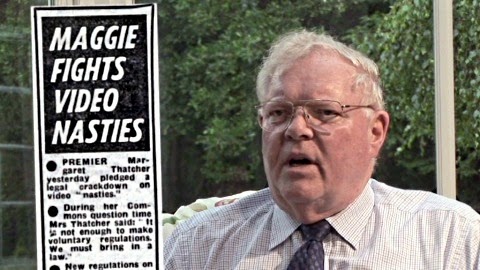
In the 1980's a wave an inquisition concerning graphic films erupted in British politics. The DPP (Director of Public Prosecutions) compiled a list of 72 films, labeled the "Video Nasties," and attempted to pass legislation banning the distribution, rental, ownership or sale of any of the entries on the list. Because of this, there was mass seizings of videos from collections and warehouses, as well as the legal prosecution of multiple distributors and store owners. The DPP constructed not only a mainline Nasty list, but a supplementary watchlist known as "Section 3", which included 80 more films, as well.


OUTRAGE!

The concern was that Nasties, a relatively new phenomena at the time, would irrevocably corrupt the nation's youth and, over time, cause massive spikes in violent crime. Many violent crime and murder cases in this era were blamed on these movies, regardless if the perpetrators had seen them or not. The most famous example of this being the murder of two-year old James Bulger by two ten-year old boys. The press insinuated the Bulger's murderers had been inspired by the film Child's Play 3. This, of course, amounted to little more than propaganda, as there was no evidence to suggest the youths had even seen the offending movie.
 

Would you fuck me? I'd fuck me.
This documentary follows the nativity of the Nasties controversy three decades ago, up until the modern era, in which many of these celluloid pariahs are still censored or completely unavailable to British consumers. Director Jake West has compiled interviews hailing from both sides of the fence; he speaks with journalists and industry insiders who oppose the legislation, and with the politicians who were the architects of the public scare. Though it is clear that West sympathizes with the former camp, he grants the latter the opportunity to explain their views. This is a thoroughly entertaining and informative documentary begging to be seen by horror fan and sociologist alike. 8/10
 
View the trailer here:


THE NEST (2014)

THE NEST (2014) (UR) Dir. David Cronenberg
9 mins.
 
The Nest is a short mini-film that David Cronenberg made exclusively for the EYE Film Institute in Amsterdam, which is hosting a gallery and retrospective of the director's works. It was filmed using a GoPro camera, in a single continuous take, and is from Cronenberg's own first person perspective. The director plays an alleged surgeon, most likely of the illegal variety, as he interrogates a visibly distraught topless woman who desires to remove her left breast.

It is not clear if the woman is insane, or if Cronenberg's character is truly a surgeon, a psychiatrist, or a charlatan. Nor is it clear if the ailment she complains of is an authentic condition or a product of her unstable imagination. See, the woman is convinced that her left breast is infested with insects. From a psychological standpoint, it is interesting to note that it is the LEFT breast; mirroring, yet updating the antiquated belief that the left hand, or sinistra, is an instrument of evil.

This nine minute, low budget experiment hints at a return of the director to the subgenre that made him a household name in the underground (and briefly, the mainstream with 1986's The Fly), and that is body horror. Fans have been clamoring for him to revisit his roots, as most of his output of late has been more dramatic in tone (i.e. A History of Violence, Eastern Promises, M. Butterfly, and A Dangerous Method). Not that these movies aren't good--they are--but because no director can make us feel like fleshly and vulnerable humanoid slugs quite like the maestro himself.

Unfortunately, The Nest is not a return to form, but is, hopefully, a hint of things that may come. The short is a little boring at worst (even with a quick running time), and suffers from dodgy acting, mostly on the part of Cronenberg himself. However the concept, in and of itself, and the back-of-the-garage appearance of the "surgery" room works to the film's advantage. As the conversation between the woman and the doctor escalates (through the use of a stethoscope he confirms he can hear a buzzing, like that of a wasp), there is a tangible sense of dread that builds... but this crescendo is abandoned in an abrupt and anticlimactic ending that provides no real explanation or closure to the premise.

In a perfect world (at least for me), at the nine minute mark the film would have cut to a scalpel as it effortlessly breaks through the fatty tissue of the contentious tit, and to the horror of a doubtful (and likely confused) audience, a gaggle of slimy, insectoid vermin crawl out. That would have been too good for us. Perhaps in the future, the perverse king will reclaim his throne, but not now.

Though doubtful that Cronenberg will pursue this story any further, it would be nice to see this concept fleshed out into a full length feature, with a decent budget and better production values. Sow doubt into the audience; have them believe the woman is a hallucinating psychotic, to the extent that when the nest is proven to be a very real and life-threatening phenomenon, it shocks the viewer in a wonderfully graphic manner. After all, internal insect infestation is a horrifying concept, and quintessentially Cronenbergian.

I would recommend this movie to die-hard Cronenberg fans only. Others will likely be left scratching their heads. It's on YouTube, but supposedly for a limited time (somehow I doubt it, though). 4/10

Wednesday, March 19, 2014

FATHER'S DAY (2011)

FATHER'S DAY (2011) (NR) Dirs. Adam Brooks, Jeremy Gillespie, Matthew Kennedy, Steven Kostanski, and Conor Sweeney
aka THE FATHER'S DAY MASSACRE
99 mins.


Like House of the Devil and Hobo with a Shotgun before it, Father's Day is recorded with the aesthetic of a late 70's or early 80's grindhouse flick. Specifically, it 's made to look like it was taped off the TV with a VHS, channel bumpers and all. There is even a fake trailer halfway through the film, a la the movie Grindhouse. Everything looks authentic; the film's frames are scratched and linty, the colors are saturated to a ridiculous degree, there are jittery splices in the footage, and the score is pure Moogy deliciousness.
 
The story revolves around the legend of the Fuchman. Chris Fuchman to be precise, an obese necrophile who likes to kidnap fathers, rape and kill them. When Fuchman kills a priest and kidnaps stripper Chelsea from the club she works at, it's up to three intrepid heroes, film noir reject and Chelsea's brother Ahab, male hooker Twink, and Father John, to rescue her and stop the Fuchman.

 
They follow in hot pursuit of Fuchman and Chelsea following the abduction, chasing Fuchman's truck, but ultimately lose him and fail to rescue Ahab's sister. The day is fading, so they pitch camp until morning. During the night, Twink and Father John eat hallucinogens and fuck.
 
The next day, they follow Fuchman's trail to a waterslide park, where they discover a corpse and a terribly wounded Chelsea. Ahab engages a fleeing Fuchman, unleashing a flurry of handgun rounds and shotgun shells into his body. After Fuchman falls, Ahab stomps in his skull and hurls the body off the side of a ledge.
 
 
The trio's victory is short-lived, although, as it is discovered that the Fuchman is actually a demon of sorts, a spirit that is reborn each generation. He has Chelsea's soul and is using her as his vessel. Yet Fuchman is in Hell. So Hell ahoy! Ahab and the boys load up a pistol and prepare to kill the Fuchman, on his home turf, and end his reincarnations.

 
Father's Day is vile, disgusting and hilarious. It revels in breaking taboos and making the audience uncomfortable. Male on male rape, Catholic homosexuality, abortion, genital mutilation, and incest, all make their appearances. The gore is both cartoonish and gruesome. The whole movie is brilliantly shot and edited, and the comedy mostly hits its mark. The acting is hammily self-aware and the many homages and parodies (i.e. Escape From New York, Twin Peaks, Phantasm) are clever and respectful.
 
Easily recommendable to gorehounds, Troma fiends, and fans of black humor. It's a goldmine, but as with most of Troma's fare, it's definitely not for the squeamish. 7/10
 

THE BLACK 6 (1973)

THE BLACK 6 (1973) (R) Dir. Matt Cimber
94 mins.


After a white girl's brother discovers that her boyfriend is black, he and his biker cronies beat the man to death with chain links. Later, the victim's estranged older brother Bubba, leader of the Vietnam vet biker gang the Black 6, receives the news. He makes his way home with his gang in tow to reconcile with his family and find out what happened to his little brother, Eddie.
 
Since the murder occurred on the local high school's football field, Bubba first questions the coach. The coach is little help, so Bubba petitions the police to no avail, but he does learn that the murderers were bikers. What does he do next? He goes bar-hopping, of course.
 
Bubba meets up with an old drunkard at the bar #1, who tells him that his high school sweetheart Lucille might have some answers. Bubba leaves to find her. He finds and threatens her pimp, Copperhead, in bar #2. Copperhead spills her whereabouts and off goes our hero. Bubba finds Lucille and she informs him that Eddie's girlfriend was named Jenny King. He drops Lucille off with his mother and heads for Jenny's workplace: bar #3.
 
 
This has got to be the breeziest investigation ever, as at the bar the gang responsible for Eddie's death are all there. It's quickly revealed to Bubba that Jenny's brother and his friends are the killers (they practically brag). The rest of the Black 6 arrive to back Bubba up against the gang, but before they can scrap, the police enter and break up the ruckus.
 
Later, the white gang meets up with another biker gang run by a strange fellow called Thor. The two gangs form an alliance to bring down the Black 6. They send two envoy riders to invite the 6 to meet up and talk things out, in what is clearly a trap. Yet the 6 bite, and they head off on their bikes much to the dismay of Bubba's mother and sister.
 
What follows is one of the most frustrating endings I've seen in a while. The lighting is so terrible, I found myself gazing at the screen in wonder for roughly ten seconds before I realized that I was looking at the front of a motorcycle. Shitty lighting, shitty fight choreography, and the sudden piss poor editing make the whole climax pretty incomprehensible. After killing many dozens of his fellow racist bikers, a desperate gang member rides his bike, with a flare in its gas tank, at the Black 6.  The motorcycle explodes in (what I assume is) midair, and the movie's over. It's so sudden, so abrupt and it really squanders all of the momentum built up during the first eighty minutes. A shame.
 
 
The actors portraying the 6 were all NFL stars of the day (their teams are listed in the opening credits), so understandably their acting is a bit wooden at best. Gene Washington is clearly the most charismatic of the bunch and he basically carries most of the film. The supporting cast is great though, and the actors portraying Lucille, Bubba's mother, the Coach, and Jenny all stand out for their strong performances.
 
The Black 6 dwells in the realm of comedy for its first third and but gets a bit darker as the film progresses. The transition is not handled well and all of the plot's setups do not pay off. Unfortunately, what could have been a great murder/revenge film is marred by bad pacing, a lack of any mystery surrounding the killers, slapstick segments (mostly early on), and most of all, a muddled and unfinished climax. Yet is has so much potential. If any cult classic should be remade, it's this one. 4/10

DR. JEKYLL AND MR. HYDE (1912)

DR. JEKYLL AND MR. HYDE (1912) (NR) Dir. Lucius Henderson
12 mins.

Though there have been a couple film adaptations of Stevenson's The Strange Case of Dr. Jekyll and Mr. Hyde before the 1912 version, this is the only one to have survived, so far. Directed by Lucius Henderson and starring future director James Cruze as the doomed doctor, the film serves as a cornerstone to not only horror, but to narrative cinema itself.

 
Dr. Jekyll is in his lab, reading up on the effects of different drugs. He is a able to concoct a new substance that separates the good half of a person from his/her evil half. Upon testing the formula, Jekyll turns into his criminal shadow-self, Mr. Hyde. He checks out his new visage in a mirror, and having succeeded in his experiment, ingests an antidote and returns to his Jekyll form. Jekyll immediately jots down his results.

 
However, experimenting with the drug over the course of a few months, Jekyll begins to transform into Hyde unwillingly. While studying one day, Hyde emerges. It's interesting to note that you can physically see Jekyll struggling for control over the Hyde personality. Kudos to James Cruze for being able to portray that in a matter of a few seconds. Hyde wins out and, after tearing Jekyll's notes, runs amok in the town streets, where he attacks a little girl. He scurries off, evades capture, and using the antidote reverts back into Jeckyll.
 
Later, when meeting with his fiancée, Jekyll begins to suffer from one of his spells. He runs off out of sight and transforms. As Hyde, he attacks his wife-to-be, and when her minister father intervenes, Hyde strangles him to death.

 
A policeman chases a fleeing Hyde to Jekyll's house, but when he reaches it, Hyde has already ingested the antidote. Dr. Jekyll appears and reassures the officer that Hyde is not there. Knowing now that he will never rid himself of Hyde, Jekyll arranges to meet his fiancée and break it off. During their meeting, he must again run off to avoid endangering her. He gets back to his house in time and morphs.
 
Inside Jekyll's home, Hyde finds that he has run out of antidote and must remain in this form indefinitely. Hyde trashes the lab and Jekyll's butler fetches the police. In desperation, as police ax down the laboratory door, Hyde drinks a flask of poison and dies.
 
Even at twelve minutes there is a lot going on in the adaptation. The pacing is very fast, especially for its time. Blink and you will miss scenes. The Hyde makeup is excellent, I can imagine very creepy for 1912 audiences, and the big dissolve used to show the initial Jekyll's initial transformation is groundbreaking. At this point, horror cinema is still in its infancy, but its teeth are starting to come in. 7/10   

THE EXECUTION OF MARY STUART (1895)

THE EXECUTION OF MARY STUART (1895) (NR) Dir. Alfred Clark
aka EXECUTION aka THE EXECUTION OF MARY, QUEEN OF THE SCOTS
18 sec.

This is arguably the very first horror film ever made, and it was produced by American inventor Thomas Edison. The idea that Edison invented the horror film is mind-twisting. Why didn't they tell me that in elementary school? The Execution of Mary Stuart consists of only one scene and runs about eighteen seconds. Interesting enough, you could also call it the world's first exploitation and splatter film.
 
It's 1587. A group stands around a blindfolded Mary Stuart, Queen of the Scots. The blindfold is removed and she kneels at a chopping block before her. The executioner raises his ax and beheads Mary for treason against Queen Elizabeth. He then picks the head up and holds it aloft.
 
That's it. Through clever early editing (this is oft considered to be the very first edited film), the actress playing Mary is substituted with a dummy, so that the decapitation can occur on camera. Wow. A hundred, and almost a quarter, years have passed since then and directors still use that dummy trick. Sorry H.G. Lewis.... the dynamic duo, Clark and Edison, did it first. 8/10

Tuesday, March 18, 2014

DON'T GO TO SLEEP (1982)

DON'T GO TO SLEEP (1982) (NR) Dir. Richard Lang
93 mins.


This made for TV movie is brought to us by none other than Mr. 90210 himself, Aaron Spelling, and was originally aired on the ABC network. The plot follows Phillip and Laura, a married couple with three kids. Well, two kids now, because a year ago, a car accident left their eldest, Jennifer, deceased. The two surviving children, Kevin and Mary, leave the city with their parents, who have decided to make a fresh start and settle into a new house in a more quiet, rural setting (house number 13666, no less). Along for the mooch is also Laura's mother, who makes a sport out of taunting the newly sober Phillip.


After the five move in, the youngest, Mary, starts hearing noises and a gravely voice calling her name at night. She screams for help, and the alarmed parents burst in her room to find Mary's bed aflame. She is rescued, and the fire squelched. Lacking any clear explanation for the occurrence, the couple have Mary retire to her brother's bedroom for the evening, but it is not long before the disturbances begin anew. Mary starts convulsing and yelling for help. When Kevin retrieves the skeptical Phil and Laura, they find Mary sound asleep and with no evidence to corroborate Kevin's story. Kevin vows payback.

So the next day, Kevin makes some (allegedly) spooky sounds on his tape recorder. That night he plays them to torment his little sister. He smirks as he feigns sleep and eavesdrops on Mary being scolded for her outburst.

On the third night, as Kevin runs off to tattle on his sister for freaking out again, Mary musters her courage and investigates the noises, which seem to be originating from beneath her brother's bunk bed. There she meets the apparition--her dead sister Jennifer, smiling intently.
 
 
When she is discovered by her parents, Mary tries to convince them that she saw Jennifer, but to no avail. Not knowing how to deal with their daughter's apparently increasing break with reality, the parents argue about seeking psychiatric help. Meanwhile, a spectral Jennifer continues to visit the confused child. She is able to convince Mary that not only is she indeed real, but that if she wants Jennifer to stay for good this time, Mary's going to have to dispose of any person that gets between them. This does not bode well for the other members of the family... who are all growing weary of Mary's antics.

As time goes on, Mary becomes more and more possessed by the spirit of Jennifer. She starts to rationalize her previous supernatural encounters. She cleverly eludes her psychiatrist's inquiries during their visits. By night she is concocting schemes with Jennifer to eliminate her pesky family members. Grandmother first, then that snitch Kevin. It's not long before she sets her murderous sights on dear ol' Dad. Laura eventually discovers what has been going on and is able to escape. Young Mary is hospitalized. During the film's denouement, we see what really happened to Jennifer the night she died in that car accident, and ladies and gents, it's fucked up. This is grim stuff for television, especially for 1982.
 
 
Don't Go To Sleep, like Dark Night of the Scarecrow, is a great example of less is more. In lieu of elaborate gore or special effects, we instead get fleshed out characters, great acting and a legitimate creepiness that is far more tangible here than in horror films that have ten times the budget. Dennis Weaver and Roth Gordon are excellent per usual, but Robin Ignico's Mary is superbly executed. Her fear during the initial hauntings is vividly pronounced and totally believable, and her frenzied, schizophrenic monologue at the climax of the film would be impressive for the most veteran of actors, let alone a child of her age.
 
Another great early 80's TV movie. Sort of like a fleshed out Twilight Zone episode meets an episode of Dark Shadows. The music is full of melodrama. It's soap-operatic. The cinematography is average for television, but the lighting is very well done, and the film's arguably scariest moments are accomplished by lighting (and good acting) alone. The conclusion is a near-Shakespearean tragedy. I mean, I truthfully feel bad for the mother, Laura. Jesus, lady. Sucks to be you. 7/10

SCHRAMM (1994)

SCHRAMM (1994) (NR)
aka SCHRAMM: INTO THE MIND OF A SERIAL KILLER
Dir. Jorg Buttgereit
65 mins.
Germany
 
 
The only other Jorg Buttgereit film I've seen so far is Nekromantik, and as much as I enjoyed that film, Schramm is easily the better of the two. The production values are higher, the acting, much more somber and realistic, and the camera movement and projection effects are incredible. The movie feels like a mixture of William Lustig's Maniac and Henry: Portrait of a Serial Killer, with a few drops of Fulci-esque gore. It's invasive, grim and uncomfortably personal, as we follow the sad life and death of the Lipstick Killer, Lothar Schramm. 


We are introduced to the titular character, a prosthetic leg-wearing cab driver, who, when he's not running in marathons or driving his prostitute friend Marianne to various jobs, is in his apartment, ejaculating onto Sears catalogues or cleaning the semen out of his inflatable vagina. Fortunately for society, Schramm is now dying, having fallen off of a step ladder while painting over some bloodstains in his apartment. Seems his prosthetic came loose, and he snapped his neck upon impact with the floor. As he slowly departs this coil, Lothar's brain floods with flashbacks of his life and the events leading up to his fall.
 
 
These flashbacks are apparently random at first, but as the film progresses we begin to flesh out a timeline. We see Lothar doing normal things like showering, going to dinner or seeing his dentist. We also see him nail his foreskin to a table... and drug and rape Marianne (his only friend, mind you). The juxtaposition of everyday tediums with his shadow life of criminal perversion is striking, to say the least. Lothar's increasing levels of delusion lead to the double murder of two Christian missionaries in his apartment. It was their stains he was painting over. Towards the climax, as the dying killer's consciousness finally dims, we see some final flashbacks to Lothar as a boy, playing with crabs by the shore with, what I assume, is his family. And we see the wildflowers that grew there, suggesting that Luthor used to be innocent once, too. It begs the question, what happened to this guy that made him so fucked up? There are no real answers, you are left to speculate, and this makes him much more interesting than your average Norman Bates clone.

There is also a quasi-afterlife scene that I don't know what to make of.


The story is simple, but interesting, the writing and acting are up to par, and the special effects are effective and fun, but the real standout in this feature is the direction and editing. It looks as though Jorg projected the movie onto a piece of warping plexiglass, creating motion blurs, trails, and proportional distortions that make for a very psychedelic experience. Even the subtitles stretch with the picture. It's an incredible way to force the audience to sympathize with Lothar's condition, as the camera emulates his own hallucinatory view of his environment.

Schramm is definitely a splatter movie, but it's equally an art film. If you're into disturbing and disorienting films, this is like foie grois. Definitely an benchmark work for the genre. The visuals are amazing, the actors are fearless... and there is a rubber vagina monster, with teeth and tentacles, living in Schramm's lipstick drawer. Can't forget to mention that. 8/10